
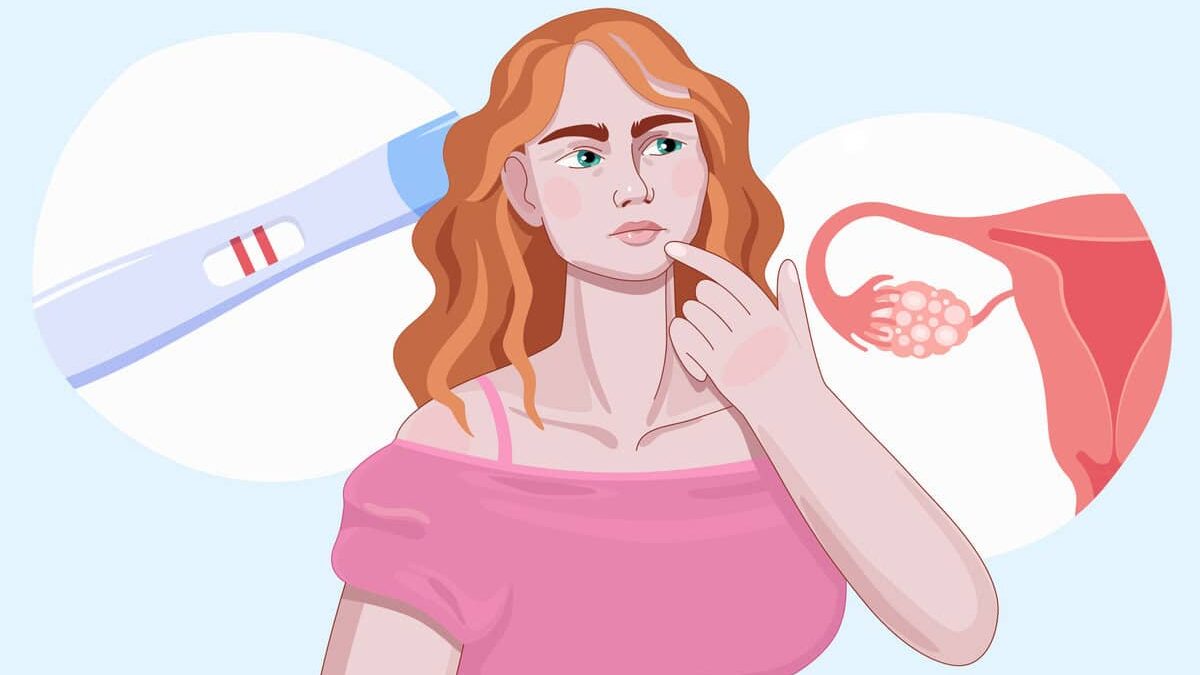
The First Thing I Say to Every PCOS Patient
“PCOS does not mean you can’t have a baby.”
I say this every single week to women sitting in my clinic in Kandivali, often with years of irregular periods, failed home pregnancy tests, and a deep anxiety that their body is broken.
It isn’t. PCOS is the most common hormonal condition in women of reproductive age in India — affecting about 1 in 5 women — and it is, without question, one of the most treatable causes of infertility we deal with. But the misinformation around it is enormous, and a lot of women suffer needlessly because of it.
So let me tell you what I actually tell my patients.
What PCOS Does to Your Fertility (And Why)
The core problem with PCOS is that your ovaries don’t reliably release an egg each month. The hormonal imbalance — too much LH, often too much testosterone, frequently insulin resistance — disrupts the maturation and release of eggs. No egg, no pregnancy. It’s that simple.
Women with PCOS often have many small follicles visible on ultrasound (the “polycystic” appearance), but none of them mature and release properly. It’s not a shortage of eggs — it’s a traffic jam.
The good news: we know how to clear that jam.
What Treatment Actually Looks Like
I tailor every PCOS patient’s treatment individually because no two women with PCOS are the same. But here’s the general approach:
Step 1: Lifestyle (Yes, Really)
I know everyone says this and it sounds like a brush-off. It isn’t. In women with PCOS who are overweight, losing just 5–10% of body weight can restore spontaneous ovulation. I’ve seen this happen many times. It’s not the whole answer for everyone, but it’s real medicine.
Step 2: Ovulation Induction
We give medications — usually Letrozole or Clomiphene — to nudge the ovary into releasing an egg. We monitor with ultrasound, confirm ovulation, and time intercourse or IUI precisely. For a lot of women, this alone is enough.
Step 3: IUI With Trigger
Combining induced ovulation with IUI significantly improves the odds. This is my go-to recommendation for PCOS patients who haven’t conceived with ovulation induction alone after 3–4 cycles.
Step 4: IVF
If none of the above works — or if there are additional factors — IVF is next. Women with PCOS actually respond very well to IVF stimulation (sometimes too well — we monitor carefully for ovarian hyperstimulation syndrome). Success rates are excellent.
One Thing That Drives Me Crazy
Women with PCOS being told by well-meaning family members to “just relax and it’ll happen.” For some women with very mild PCOS, maybe. For most — no. Untreated PCOS with anovulation means month after month with no egg released, no matter how relaxed you are.
If you have PCOS and you’re trying to conceive, please see a specialist. Not because something is terribly wrong — but because the right treatment can get you pregnant far sooner than hoping and waiting.
Let’s Make a Plan Together
At Punit Fertility, Kandivali, I’ve helped hundreds of women with PCOS conceive. Most didn’t need IVF. Most had a much shorter journey than they feared.